You’ve likely seen headlines like “Voters Open to AI Running Government Departments.” Your first thought may be skepticism. But here’s the real story: it’s not just about government—it’s about trust in systems that work consistently and transparently.
At Atlas Unchained, we work daily with small and mid-sized businesses, navigating AI implementation for small businesses. The verdict is clear: AI, when implemented correctly, produces results that are difficult to achieve with human effort alone.
The question isn’t whether AI should run government departments. It’s: why are businesses and individuals willing to trust machines with decisions that impact real outcomes?
This insight highlights a fundamental shift in digital transformation: organizations that leverage AI correctly gain a clear operational advantage, whether in business or public administration.
The Trust Gap Driving AI Adoption
Trust in institutions—government agencies, corporate bureaucracies, even service providers—is at an all-time low. People are frustrated by slow processes, inconsistent outcomes, and decisions that appear political rather than practical.
AI is emerging as a solution to this problem.
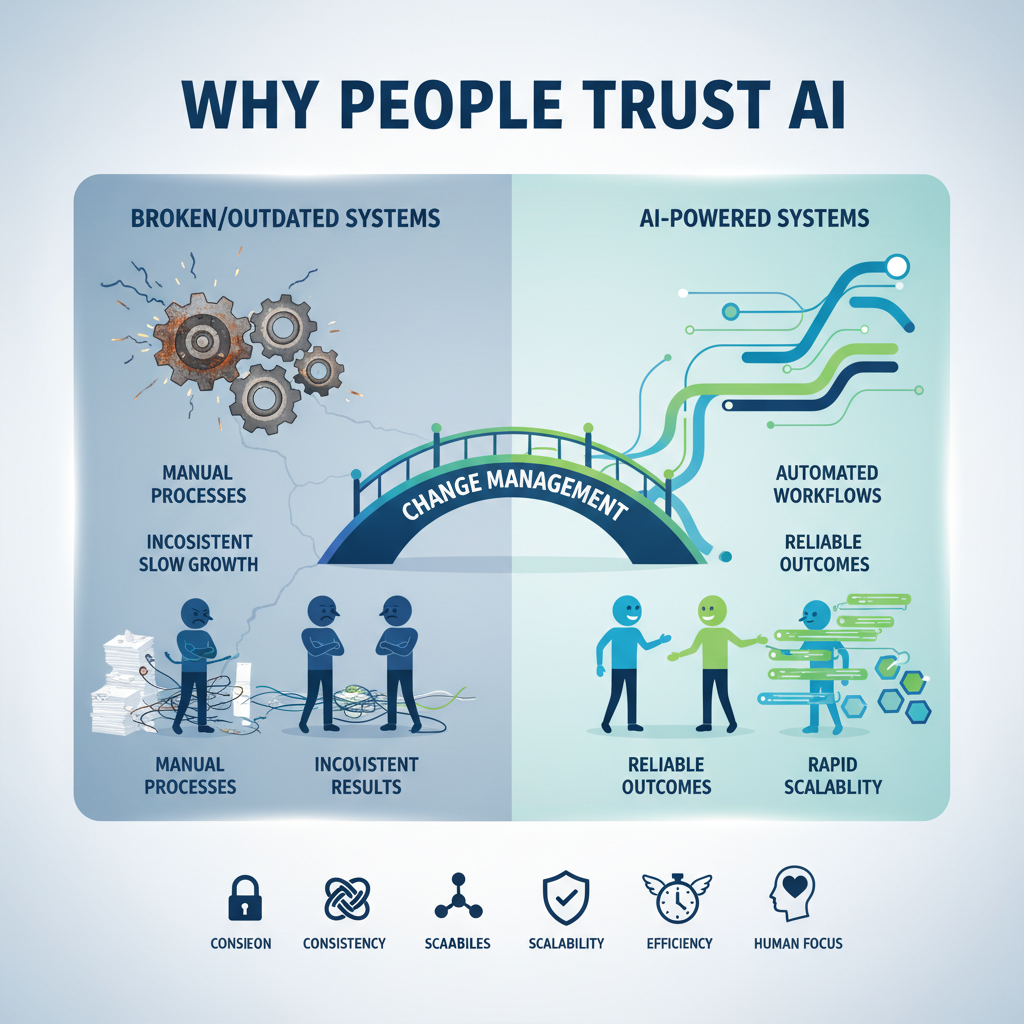
People aren’t trusting AI because they love robots—they’re trusting AI because it removes human inconsistency and bias:
- No political or personal bias – AI applies the same rules fairly
- Faster processing – Tasks that once took months now take minutes
- Transparent decisions – Every step can be traced and audited
- Consistent outcomes – Decisions follow logical, programmed rules
In business, this trust translates directly into operational efficiency. For example, a small company implementing AI-powered customer service doesn’t replace employees—they free them to handle higher-value work.
In government, AI can streamline permit approvals, optimize traffic management, or analyze public health trends faster than traditional methods. The principle is the same: people trust consistent, rule-based systems more than unpredictable, politics-driven ones.
3 Reasons Organizations Are Embracing AI
1. Performance Over Perfection
AI doesn’t need to be flawless; it needs to outperform the existing process. Consider a government agency processing permits: AI may occasionally make errors, but if it processes 10,000 applications in the time it previously took to handle 1,000, the overall efficiency gain is enormous.
Similarly, in business, AI-assisted workflows reduce unnecessary decision-making without eliminating human judgment. The result? Faster outcomes, improved results, and more satisfied employees.
Small businesses that have implemented AI-assisted operations report:
- Shorter response times
- Reduced workload for repetitive tasks
- More time for strategy, growth, and innovation
Case Example: A mid-sized retail company implemented AI to handle online order inquiries. Before AI, staff spent hours answering routine questions about shipping and returns. After implementation, response times dropped to under five minutes, customer satisfaction scores increased by 25%, and staff could focus on marketing and product development.
The lesson is clear: AI is not about replacing humans—it’s about enhancing human capability.
2. Scalability Without Proportional Cost
One of the biggest challenges for businesses and government agencies alike is scalability. Population growth and business expansion often outpace resources. Hiring more staff isn’t always feasible.
AI allows organizations to scale operations efficiently. One employee equipped with AI tools can accomplish what previously required several staff members. This is business automation in action: maximizing output without proportionally increasing costs.
For example, a small business owner spending 20 hours per week on administrative tasks can reclaim that time to focus on client relationships, strategy, and growth. AI effectively decouples output from headcount, creating scalable systems without overwhelming teams.
Government Example: AI-assisted data analysis in public health can process massive datasets in hours that would take human teams weeks. This leads to faster responses during health crises, better resource allocation, and more effective policy decisions.
3. Consistency and Accountability
AI systems are fully auditable. Every decision can be traced, biases can be analyzed, and performance can be measured. Human decision-making, in contrast, often lacks transparency:
- Permit applications may be denied for unclear reasons
- Hiring decisions may be influenced by unconscious bias
- Customer support answers may vary between representatives
With AI, every step of the decision-making process can be monitored, ensuring accountability and consistency, which paradoxically increases trust in the system.
Beyond Efficiency: AI as a Strategic Advantage
AI is not just a tool for efficiency—it is a strategic differentiator. Organizations that adopt AI effectively gain advantages that go beyond operational improvements:
- Improved Customer Experiences – AI-powered systems provide instant responses, personalized recommendations, and consistent service.
- Data-Driven Decision-Making – AI identifies trends and insights that humans might overlook, enhancing strategic planning.
- Enhanced Workforce Productivity – Employees can focus on tasks that require creativity, empathy, and judgment.
- Competitive Advantage – Businesses that implement AI workflows outperform competitors in speed, accuracy, and innovation.
For small business owners, this might mean automating repetitive marketing tasks with our [Digital Marketing Services] or using AI to enhance customer experience on their website through [Website Development] solutions.
In addition, AI-driven analytics allow companies to refine their strategies based on real-time insights, creating scalable business systems that grow with the organization.
The Real Barrier: Change Management, Not Technology
The technology itself is rarely the challenge. The bigger obstacle is changing how people work. Many AI initiatives fail because employees:
- Resist new workflows
- Lack of understanding of AI capabilities
- Are uncertain about job security
- Don’t trust automated decisions
Strategies for Successful Change Management:
- Clear Communication – Explain why AI is being introduced and its benefits.
- Training Programs – Build skills and confidence in using AI tools.
- Transparency in Decision-Making – Show how AI arrives at decisions.
- Feedback Mechanisms – Allow employees to report issues or suggest improvements.
- Gradual Rollout – Introduce AI in stages to reduce disruption and build trust.
Whether for government modernization or business efficiency, change management accounts for 80% of success, while technology contributes only 20%.
AI in Action: Real-World Examples
Business Example: A regional healthcare provider implemented AI to triage patient inquiries. Response times dropped by 60%, patients reported higher satisfaction, and staff could focus on providing personalized care.
Government Example: City traffic management systems use AI to monitor congestion patterns in real time. The result? Reduced commute times, fewer accidents, and better resource allocation for infrastructure planning.
Small Business Example: A boutique marketing agency used AI for workflow automation in campaign reporting. The system automatically generated performance reports, freeing staff to focus on creative strategy, resulting in faster campaign launches and higher client retention.
These examples illustrate that AI trust in business and government is built on measurable, consistent outcomes rather than novelty or hype.
Why Businesses Should Care About AI
Even if you are not in government, these lessons apply. The same factors driving AI adoption in public agencies are shaping business expectations:
- Customer expectations – Faster responses and personalized service are now standard.
- Employee expectations – Teams want modern tools that enable productivity and creativity.
- Investor expectations – Automation reduces costs and improves AI ROI.
- Market expectations – Businesses embracing AI innovate faster and grow more efficiently.
Organizations that succeed today are those that combine human expertise with intelligent, automated systems.
To leverage AI for growth, consider exploring:
- Digital Marketing Services for AI-powered marketing automation
- Website Development to enhance user experience
- Business Consulting for change management and implementation strategy
- SEO Services for AI-powered content optimization
How to Implement AI: A Step-by-Step Framework
- Audit Your Processes – Identify inefficiencies, bottlenecks, and inconsistent outcomes.
- Start Small – Focus on one area, implement AI, measure results, then scale.
- Invest in Change Management – Training and communication are critical.
- Measure and Iterate – Track performance, adoption, and unexpected outcomes. Adjust as needed.
- Scale Strategically – Apply AI to additional processes once the initial implementation is successful.
This approach ensures workflow automation, business efficiency, and long-term scalability.
Frequently Asked Questions About AI in Business
Will AI replace my employees?
No. AI replaces repetitive tasks, not people, allowing teams to focus on higher-value work.
How do I know if AI is right for my business?
If your organization handles repetitive, high-volume, or inconsistent processes, AI is likely a good fit. Start with a workflow audit.
What’s the ROI on AI implementation?
ROI varies, but clients often see results within 6–12 months through efficiency gains, error reduction, and scalability improvements.
How long does implementation take?
Most AI projects take 3–6 months from planning to full deployment. Starting small and scaling gradually is the best strategy.
What about data security and privacy?
AI vendors should prioritize security, implement access controls, and comply with relevant regulations to protect sensitive information.
AI Trends and the Future Outlook
The adoption of AI is accelerating, and businesses that stay ahead will thrive. Key trends include:
- Predictive Analytics – AI can forecast market trends and customer behavior to drive smarter decisions.
- Natural Language Processing (NLP) – AI chatbots and virtual assistants enhance customer service and engagement.
- Integration Across Platforms – AI is increasingly embedded into CRM, ERP, and marketing automation systems.
- Ethical AI Practices – Transparency, fairness, and compliance are becoming critical for trust and adoption.
Understanding these trends helps businesses remain competitive and ensures sustainable AI ROI.
Ready to Transform Your Business with AI?
At Atlas Unchained, we help small and mid-sized businesses implement AI-powered systems that drive growth, improve efficiency, and scale operations. From automating customer service to streamlining workflows, we provide the guidance and expertise needed for successful AI adoption.
Schedule a Free Consultation – Explore how AI can work for your business today.