It’s 2 AM. Your AI-powered system just made a decision that could cost your business tens of thousands of dollars. Maybe a chatbot gave a client the wrong medical advice. Perhaps your automated hiring tool filtered out qualified candidates, or a predictive analytics model recommended a risky investment that resulted in a six-figure loss.
Scary? Absolutely. But these scenarios are happening more often than business leaders realize. When mistakes occur, liability lands squarely on your shoulders—not the vendor’s.
This is why AI liability insurance is becoming a critical consideration for businesses of all sizes. However, insurance alone isn’t enough. The most successful organizations combine prevention, governance, and financial protection to mitigate both financial and reputational losses.
In this guide, you’ll learn:
- What AI liability insurance covers (and what it doesn’t)
- Why AI systems fail and the impact on your business
- Key technical safeguards and governance practices
- Emerging AI risks and real-world examples
- How to create a robust AI risk management strategy
The Hook — Your AI Just Made a $50,000 Mistake. What Happens Now?
AI can be transformative, offering automation and predictive insights that drive growth. Mistakes, however, can happen at any moment. Fortunately, AI liability insurance helps mitigate the financial fallout from such errors.
Imagine this: it’s late at night, and your AI-powered analytics system miscalculates a pricing recommendation. Your sales team acts on it, and the company loses $50,000 before anyone notices.
Or your AI-driven HR platform rejects several qualified candidates due to algorithmic bias embedded in historical hiring data. Weeks later, complaints escalate to lawsuits.
Even worse, AI errors can affect compliance, leading to fines and regulatory scrutiny.
This is where AI liability insurance enters the conversation. It protects your business financially after a mistake—but prevention, oversight, and accountability are what truly keep your business safe.
AI tools like chatbots, automation platforms, and predictive analytics can transform operations—learn more about our Business Automation & AI Services to see how.
What Is AI Liability Insurance?
AI liability insurance is a specialized coverage designed to protect businesses from financial losses caused by AI systems. Think of it as professional liability for your algorithms.
It’s particularly critical for businesses deploying AI in high-stakes areas such as:
- Finance: Automated investment advice or fraud detection
- Healthcare: AI-assisted diagnostics or treatment recommendations
- Human Resources: Automated hiring and performance evaluations
- Supply Chain: Predictive analytics for inventory and logistics
- Customer Service: AI chatbots handling sensitive inquiries
Traditional insurance often doesn’t cover AI-specific risks, making this type of policy essential.
For companies looking to strengthen governance and compliance, we recommend reviewing our Digital Transformation Services page to align AI initiatives with risk management frameworks.
What AI Liability Insurance Typically Covers
Most AI liability policies provide coverage for:
- Legal defense costs for AI-related lawsuits
- Financial damages resulting from AI errors
- Certain regulatory penalties
- Crisis management and public relations support
- Data breach notification and remediation
- Some cyber incidents are tied to AI systems
Insurance is reactive—it covers costs after a mistake. Prevention and governance are what keep mistakes from happening in the first place.
Helpful Outbound References
To align with industry standards and insurer expectations:
- EU AI Act Overview – European AI regulations
- NIST AI Risk Management Framework – U.S. guidelines for AI risk
- OECD AI Principles – Ethical AI practices worldwide
Following these frameworks reduces liability exposure and supports responsible AI deployment.
Why AI Systems Fail — And What It Means for Your Business
From over 100 AI implementation projects across industries, three primary failure types consistently emerge:
1. Algorithmic Bias and Discrimination
AI learns from historical data. If the data is biased, the AI replicates the bias.
Example: A tech company implemented an AI-driven hiring tool. Historical data favored male candidates for technical roles. The AI system replicated this pattern, rejecting qualified female applicants. This led to discrimination claims, reputational damage, and regulatory scrutiny.
Guidance: EEOC on AI in hiring
Risks:
- Employment discrimination lawsuits
- Loss of brand trust
- Public scrutiny and negative press
Mitigation: Use bias audits, diversify training data, and implement fairness constraints.
2. Data Privacy and Security Failures
AI systems require vast amounts of data, which increases exposure to privacy violations and cyberattacks.
Example: A healthcare AI system trained on patient records without proper anonymization was breached. HIPAA violations and lawsuits followed, along with long-term reputational harm.
References:
Risks:
- Regulatory fines (up to 4% of global revenue under GDPR)
- Exposure of sensitive data
- Loss of customer trust
Mitigation: Implement data encryption, access controls, and regular audits.
3. Lack of Explainability (“Black Box AI”)
Many AI models operate as “black boxes,” giving decisions without explanation. Regulators now demand transparency, especially in sectors like finance, healthcare, and HR.
Example: A bank’s AI system denied a loan. The applicant demanded the reasoning behind the decision. The bank couldn’t explain the AI’s reasoning and lost the case.
Reference: NIST Explainable AI Initiative
Risks:
- Compliance violations
- Legal disputes
- Potential system shutdowns
Mitigation: Incorporate explainability testing and maintain documentation on decision logic.
4. Emerging AI Risks
AI is evolving fast, and new risks are appearing:
- Generative AI errors: Chatbots or content generators producing inaccurate, harmful, or copyrighted material
- Automated decision escalation: AI systems making high-stakes decisions without human oversight
- Regulatory gaps: Rapidly changing AI laws create compliance challenges
Proactive risk management reduces the chance of costly mistakes.
What AI Liability Insurance Covers — and What It Doesn’t
What It Covers
- Professional liability from AI-generated advice
- Financial damages from AI errors
- Certain regulatory penalties
- Cyber incidents involving AI
What It Doesn’t Cover
Insurance generally does not protect you if:
- You used AI irresponsibly
- You ignored mandatory compliance frameworks
- Your data was unprotected
- You failed to supervise AI decisions
- There is long-term reputational loss
Key takeaway: Insurance mitigates financial fallout; governance prevents the mistake.
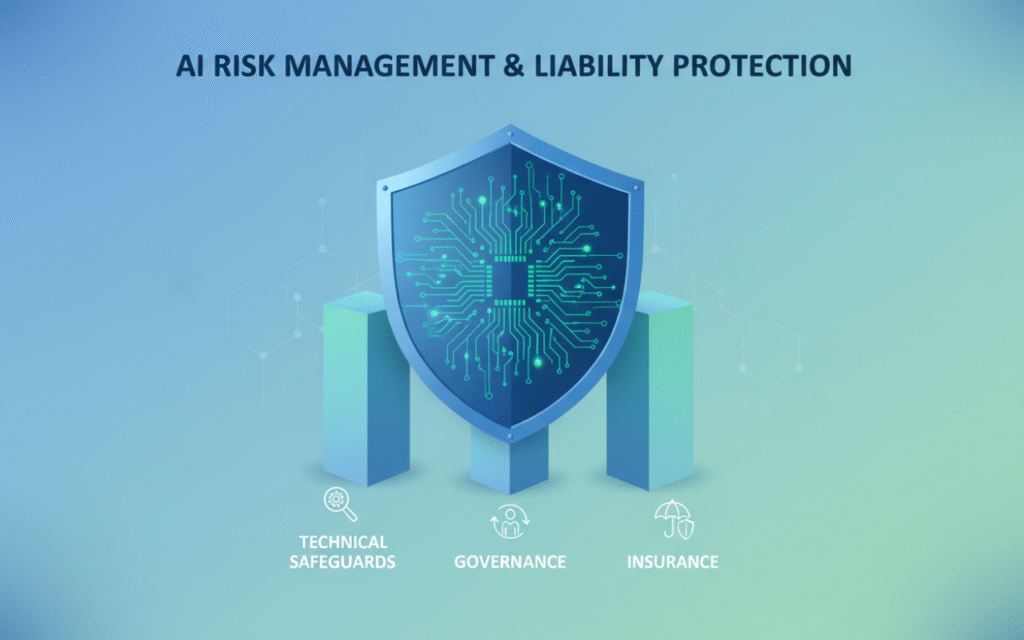
The Three Pillars of AI Risk Management
Effective AI protection requires a layered approach.
Pillar 1 — Technical Safeguards
Before deploying AI, businesses need:
- Bias testing across demographics
- Security audits to protect data and models
- Explainability assessments for transparent decision-making
- Performance monitoring to track anomalies
Reference: IBM AI Fairness Resources
Pillar 2 — Governance and Accountability
AI requires human oversight. Best practices include:
- Assigning system owners
- Performing quarterly audits
- Maintaining change logs for algorithms
- Documenting training data
- Establishing clear escalation paths
Reference: ISO AI Standards (SC 42)
Pillar 3 — Insurance and Legal Protection
Once safeguards are in place, layer in financial protection:
- AI liability insurance
- Technology E&O coverage
- Cybersecurity insurance
- Legal disclaimers and updated contracts
Reference: NAIC AI Guidelines
People Also Ask — Common Questions About AI Liability Insurance
Do I need insurance if I use ChatGPT or similar tools?
If AI influences client work or business decisions, yes—you should consider coverage.
How much does AI liability insurance cost?
Small to mid-size businesses typically pay $2,000–$10,000 annually, depending on complexity and industry risk.
Can AI operate without human oversight?
Legally and ethically, no. Significant decisions require human review.
Reference: White House AI Bill of Rights
The Atlas Unchained Method for Safe AI Deployment
We help businesses implement AI with built-in guardrails. Our five-step framework:
Step 1 — Audit
Identify risks, data sources, and opportunities.
Step 2 — Design
Build systems that prioritize fairness, privacy, and explainability.
Step 3 — Test
Conduct bias audits, security testing, and model validation.
Step 4 — Deploy
Launch with monitoring, documentation, and human oversight.
Step 5 — Monitor
Quarterly audits and ongoing compliance updates.
Your AI Protection Action Plan
Step 1 — Inventory All AI Tools
Document every AI-driven system across your organization.
Step 2 — Assess Data and Decision Flows
Write down:
- What data does it use
- Who has access
- What decisions does it influence
Step 3 — Strengthen Legal & Insurance Safeguards
Meet with:
- A tech-focused insurance broker
- A lawyer familiar with AI regulations
Step 4 — Establish Ongoing Governance
Create a small oversight team (even two people are enough).
FAQs About AI Liability and Risk
Is AI liability insurance legally required?
Not yet—but regulations are trending that way (EU AI Act, NIST guidelines, etc.).
Which industries face the highest risk?
Healthcare, finance, HR, insurance, legal, and education.
What’s the difference between cyber liability and AI liability insurance?
- Cyber covers breaches & attacks
- AI liability covers harmful decisions made by algorithms
The Bottom Line — AI Risk Is Manageable
AI offers enormous advantages—but it also creates new liabilities. The good news? With technical safeguards, governance, and insurance, businesses can confidently deploy AI without unnecessary exposure.
AI risk isn’t something to fear—it’s something to manage.
Ready to Implement AI Safely?
Atlas Unchained helps businesses deploy AI with:
- Full AI risk audits
- Compliance-aligned implementation
- Governance frameworks
- Monitoring and risk reporting
- Safe and responsible automation
Unlock the benefits of AI—without the hidden risks.
Schedule a consultation today and get a free AI risk assessment.