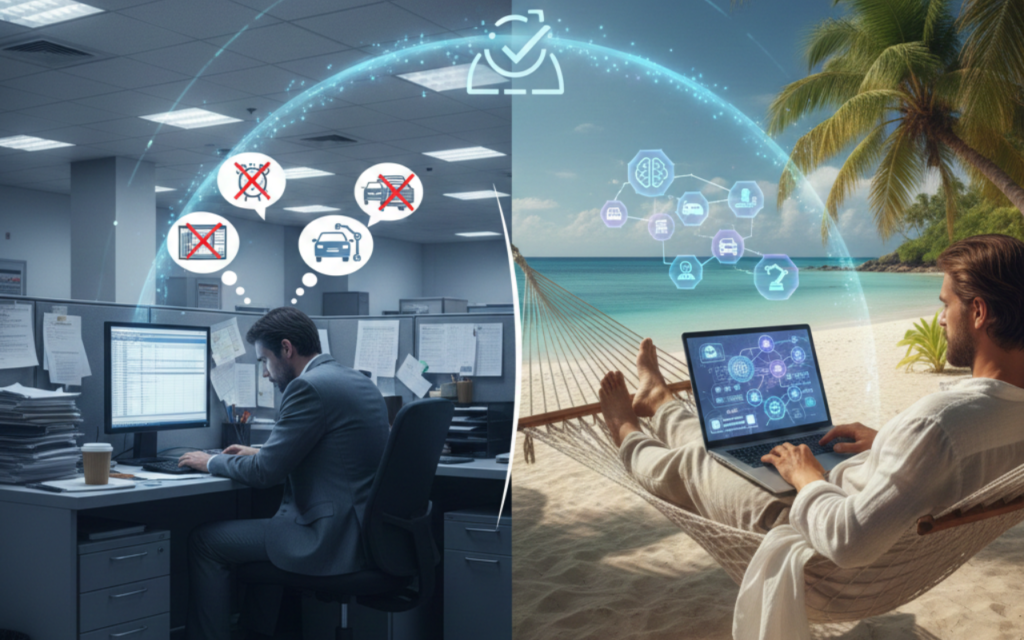
Why the Digital Nomad Dream Used to Feel Like a Trap
The original digital nomad lifestyle was marketed as freedom.
In reality, it often felt like controlled chaos.
You weren’t just working remotely—you were constantly:
- Calculating time zones
- Chasing stable Wi-Fi
- Sitting in meetings at unreasonable hours
- Managing logistics instead of momentum
Remote work looked flexible on the surface, but underneath it depended entirely on you being present, alert, and available.
It wasn’t freedom.
It was dependency with better scenery.
By 2026, that version of remote work will feel outdated. The people thriving today aren’t just changing where they work. They’ve redesigned how work happens.
The difference is artificial intelligence.
At Atlas Unchained, we’ve always believed flexibility isn’t a mindset—it’s an operating system. AI is no longer experimental or optional. It’s the infrastructure that allows businesses to function without constant human supervision.
AI and Remote Work in 2026: A Structural Shift, Not a Trend
Remote work didn’t disappear after the early 2020s. It matured.
At first, businesses went remote out of necessity. Video calls, cloud tools, and messaging apps helped teams survive, but they didn’t solve the deeper problem: work was still designed around real-time human coordination.
By 2026, that model has quietly collapsed.
Business researchers and economic analysts—especially those publishing insights through organizations like McKinsey—have been tracking the rise of generative AI in knowledge work. Their conclusion is consistent: a significant percentage of daily professional tasks no longer require direct human involvement.
Not because humans are being replaced, but because:
- Coordination can be automated
- Information can be synthesized
- Routine decisions can be handled without delay
This marks the real shift.
Remote work without AI is just distributed effort.
Remote work with AI becomes autonomy.
From Remote Work to AI-Enabled Autonomy
One of the biggest myths about AI is that it replaces people.
In reality, AI replaces friction.
It removes:
- Manual follow-ups
- Status-check meetings
- Repetitive decisions
- Constant inbox monitoring
AI-enabled autonomy means your business no longer waits for you to push every button.
Instead of asking:
- “Did this get done?”
- “Who’s handling this?”
- “What did I miss?”
Your systems already know—and update you only when judgment is required.
Global organizations studying the future of work, including the World Economic Forum, often describe this as a reduction in cognitive load. The work still exists, but it no longer demands continuous human attention.
For founders, consultants, and small business owners, this distinction is everything.
You can finally step away without things stalling.
Travel Is No Longer a Disruption—It’s Designed Into the Workflow
In 2026, travel doesn’t hurt productivity.
Poor systems do.
The professionals who travel while growing their businesses aren’t better at multitasking. They’ve simply stopped designing work around real-time presence.
Thought leadership published by outlets like Harvard Business Review has consistently shown that asynchronous teams—especially those supported by AI—make clearer decisions, experience less burnout, and outperform teams that rely on constant meetings.
When AI handles:
- Scheduling
- Coordination
- Information synthesis
Time zones stop mattering. Meetings stop being mandatory. Presence stops being the currency of value.
At Atlas Unchained, we design AI agents to act like silent operators—keeping work moving, decisions summarized, and priorities clear, whether you’re at home or halfway across the world.
Digital Nomad AI Tools That Actually Create Freedom in 2026
Not every AI tool creates flexibility. Some just add noise.
The difference between freedom and overwhelm is intentional system design.
Intelligent Scheduling That Thinks Ahead
Scheduling used to be a minor annoyance. In remote work, it became a productivity drain.
In 2026, intelligent schedulers don’t just book meetings. They:
- Anticipate conflicts
- Adjust for travel and recovery time
- Reduce unnecessary meetings altogether
- Protect deep work automatically
Instead of negotiating availability, your calendar adapts.
The result isn’t just saved time—it’s mental clarity.
AI Communication That Replaces Meetings
Most meetings exist because information is scattered.
Modern AI communication tools solve that by:
- Condensing long conversations into clear summaries
- Highlighting decisions and unresolved risks
- Assigning next steps automatically
Industry analysts, including those at Gartner, have observed that teams using AI-driven meeting synthesis dramatically reduce meeting volume while improving execution quality.
You stay informed without being constantly present.
Predictive Outreach That Grows Your Business While You’re Offline
Growth used to require constant attention.
In 2026, AI-driven outreach systems:
- Identify high-intent prospects
- Adapt messaging automatically
- Maintain momentum without manual input
Enterprise research teams studying AI in customer engagement—such as those at Salesforce—have shown that predictive outreach doesn’t just save time. It improves conversion quality.
Your pipeline shouldn’t pause because you’re on a plane.
Why Flexibility Is Becoming a Survival Skill
In 2026, flexibility isn’t aspirational—it’s defensive.
Markets shift faster. Client expectations evolve overnight. Platforms change rules without warning. Businesses built on rigid schedules and manual processes don’t just struggle—they snap under pressure.
Organizations designed with AI-supported workflows recover faster from disruption because fewer decisions depend on real-time human availability.
Flexibility, in this sense, isn’t about lifestyle.
It’s about resilience.
Trust Is the New Productivity Metric
One of the most overlooked shifts in AI-powered remote work is trust.
Old model:
- Visibility created confidence
- Hours implied effort
- Presence signaled commitment
New model:
- Systems create confidence
- Outcomes define effort
- Reliability signals commitment
Management thinkers writing about modern organizations emphasize that high-performing remote teams don’t rely on surveillance. They rely on clear systems and predictable outcomes.
AI reinforces trust by making work visible without being intrusive.
The Psychological Shift: From “Always On” to Intentionally Available
Before AI-enabled workflows, stepping away felt risky.
You worried about missing something important.
AI changes that.
When systems summarize, prioritize, and flag what matters, your attention no longer needs to stay in a constant state of alert. You move from being always on to intentionally available.
Workplace psychologists studying burnout have noted that this shift alone dramatically improves well-being—not because people work less, but because their attention is no longer fragmented.
Flexibility in 2026 isn’t about escaping work.
It’s about protecting attention.
AI as a Cultural Force Inside Remote Teams
AI doesn’t just change workflows. It reshapes culture.
In well-designed organizations:
- Busyness stops being rewarded
- Clarity becomes the standard
- Outcomes replace optics
AI removes the incentive to perform productivity and replaces it with real contribution.
Culture stops being enforced through presence and starts being reinforced through systems.
Why Small Businesses Have an AI Advantage in 2026
There’s a misconception that AI benefits large enterprises first.
In reality, small businesses often win faster.
They have:
- Fewer legacy systems
- Less bureaucracy
- Shorter decision cycles
AI researchers consistently point out that agility—not scale—is the biggest predictor of successful AI adoption.
A small team with clear processes and well-designed AI systems can outperform much larger organizations drowning in complexity.
This is why AI automation for small businesses isn’t about competing head-to-head with corporations—it’s about outmaneuvering them.
Designing Redundancy Without Bureaucracy
Flexibility doesn’t mean fragility.
Well-designed AI-powered businesses include redundancy without adding layers of approval.
That looks like:
- Automated backups
- Seamless task handoffs
- Multiple communication channels condensed into one source of truth
Risk analysts often describe this as operational elasticity—the ability to stretch without tearing.
Ethical AI Use: A Business Differentiator
As AI becomes embedded in daily operations, ethical use matters more than ever.
Clients increasingly care about transparency and trust.
Forward-thinking organizations treat AI as an assistant—not a deception tool. Academic and ethics-focused institutions emphasize that long-term trust is built when AI supports human decisions rather than obscuring them.
At Atlas Unchained, AI augments judgment. It doesn’t replace accountability.
Case Study: Scaling While Traveling
A consulting firm came to Atlas Unchained, convinced that growth required constant involvement from the founder.
Every lead, every onboarding decision, every approval flowed through one person.
We redesigned the system.
AI handled:
- Lead qualification
- Client onboarding
- Daily executive summaries
Instead of dashboards, the founder received concise daily briefings—what changed, what mattered, and what required judgment.
The result:
- A three-week working trip across Europe
- Higher deal volume than the previous month
- Less than 90 minutes of active work per day
- Faster client response times
That’s not luck.
That’s system design.
The Future of Work in 2026: What’s Actually Changing
The future of work isn’t about working less.
It’s about working with leverage.
Business schools and research institutions like MIT Sloan have shown that AI-enabled organizations outperform peers by reallocating human effort toward strategy, creativity, and judgment.
In 2026:
- AI supports execution
- Humans provide direction
- Presence becomes optional
The Real Question Founders Should Ask
The question isn’t:
“Can AI help my business?”
The real question is:
“What breaks if I step away for two weeks?”
If the answer is “everything,” the problem isn’t your work ethic.
It’s your systems.
Freedom Is a Design Decision
AI and remote work in 2026 have removed excuses.
The tools exist.
The models are proven.
The advantage is real.
Freedom is no longer something you earn after burnout.
It’s something you design upfront.
Ready to Unchain Your Business?
Atlas Unchained helps founders build AI-powered systems that:
- Scale operations
- Protect time
- Enable true flexibility
Stop discussing. Start doing.