If you’re leading a sales team in 2025, you’ve probably been bombarded with AI promises:
- “This tool will automate your entire pipeline.”
- “AI will replace your SDRs.”
- “This platform will 10x your conversions.”
Here’s the truth: most of these claims didn’t deliver measurable results.
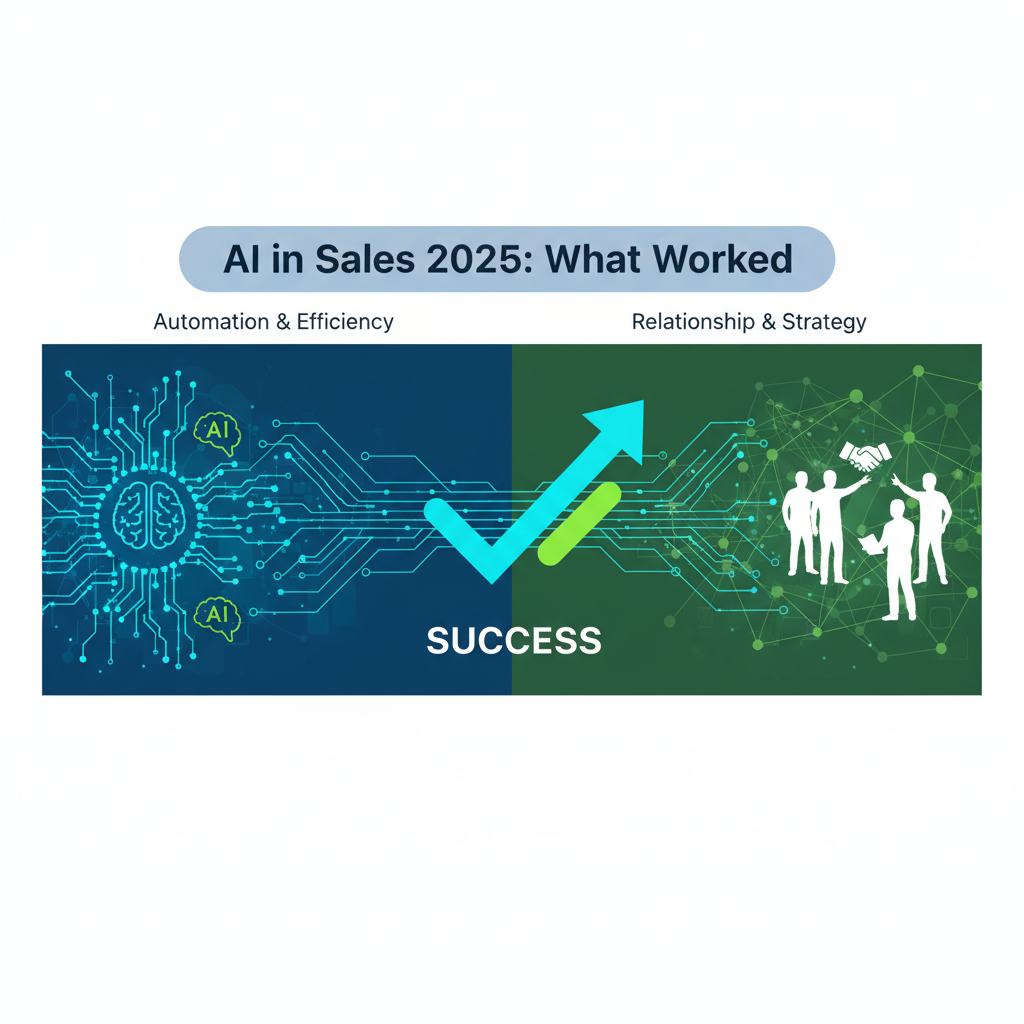
The companies that actually saw ROI in AI-powered sales treated AI as a strategic enhancer, not a silver bullet. They integrated AI into existing workflows, kept humans involved, and focused on the metrics that truly matter.
In this article, we’ll walk you through:
- What actually worked in 2025
- What failed and why
- Key AI trends to watch in 2026
- How to prepare your sales team for the future
By the end, you’ll understand how to use AI strategically to boost productivity, efficiency, and revenue—without chasing hype.
What Actually Worked in 2025: Real Insights from AI in Sales
1. AI-Powered Lead Scoring: Prioritize, Don’t Replace
The most impactful AI applications in 2025 didn’t replace reps—they helped them work smarter.
Why it worked:
- Sales reps stayed in control
- AI provided transparent, data-driven insights: industry fit, engagement signals, and company size
- Teams trusted the tool, increasing adoption
Results from top-performing teams:
- 40–60% reduction in time spent on low-quality leads
- 25–35% faster sales cycles
- Higher close rates on prioritized accounts
Example: A mid-sized SaaS company used AI lead scoring to analyze historical deal data and engagement trends. By focusing on high-value leads, reps increased closed deals by 18% in six months.
Pro Tip: Pair AI lead scoring with predictive analytics to identify accounts most likely to convert, optimizing both inbound and outbound efforts.
Learn more about Sales Strategy services for implementing lead scoring AI effectively.
2. Personalized AI-Assisted Outreach
Generic AI emails were largely ineffective in 2025. What worked was human-first messaging with AI support.
Best practices:
- Create 3–5 core email templates
- Use AI to personalize openings, product mentions, and CTAs for each segment
- Maintain consistent brand voice
- Track meaningful metrics like replies and meetings booked, not just opens
Results: Teams saw 15–25% higher reply rates compared to fully automated campaigns.
Example: A B2B software company analyzed past outreach successes, created templates, and used AI to personalize messaging for 10 top industries. Response rates rose 20%, and meetings booked increased 12% in one quarter.
Pro Tip: Let AI suggest personalization points, but ensure the core message is human-written for authenticity.
3. AI for Sales Enablement: Research and Prep
AI shone as a research assistant in 2025, dramatically reducing prep time.
Applications:
- Quickly gather company news, funding updates, leadership changes, and industry trends
- Generate talking points and objection-handling scripts
- Create competitive battle cards
- Draft follow-up emails for reps to edit
Impact: Prep time dropped from 30 minutes to just 5 minutes per lead, freeing reps to focus on selling.
Example: An enterprise B2B firm implemented AI for prospect research. Reps handled 3–4 times more leads, improving pipeline coverage and conversion rates.
Pro Tip: Use AI to monitor prospect social media, websites, and news updates—this makes calls more relevant and engaging.
Check Business Consulting services to see how AI can enhance sales enablement.
4. Pipeline Forecasting and Predictive Analytics
AI forecasting matured in 2025 by leveraging existing CRM data. The most effective tools didn’t require workflow changes but offered actionable insights.
Benefits:
- 20–30% reduced forecast variance
- Early identification of at-risk deals
- Discovery of upsell and cross-sell opportunities
- Better visibility for sales managers
Example: A SaaS company integrated predictive analytics AI with Salesforce. At-risk accounts were flagged, leading to 10% additional revenue from existing clients in just one quarter.
Pro Tip: Combine forecasting AI with lead scoring AI to align pipeline predictions with high-value opportunities.
5. AI-Assisted Analytics and Reporting
AI also improved reporting efficiency, automating daily summaries and performance tracking.
Use cases:
- Daily pipeline health reports
- Identifying top-performing reps and segments
- Highlighting bottlenecks in sales stages
Result: Teams gained faster insights, enabling better decision-making and more time for coaching and strategy.
Pro Tip: Integrate AI reporting with Tableau or Power BI for real-time dashboards.
6. AI for Customer Insights and Behavior Analysis
AI helped sales teams understand customer behavior and identify new revenue opportunities.
Results:
- Real-time cross-sell and upsell opportunities
- 30–40% improved segmentation accuracy
- Hyper-targeted campaigns that resonated with customer needs
Example: An enterprise software provider used AI to monitor feature usage, targeting upgrades with a 22% conversion rate, double the historical average.
Pro Tip: Use AI-driven insights across sales and marketing teams for consistent messaging.
What Flopped in 2025: Lessons Learned
- Full AI Sales Reps: Chatbots could not replace human SDRs.
- Real-Time AI Call Coaching: Distracted reps; post-call analysis worked better.
- Fully Automated Outreach: AI-only campaigns often ended up in spam.
- Generic AI Content: Blogs, case studies, and collateral written fully by AI underperformed.
Key takeaway: AI is best used as a force multiplier, not a replacement.
Example: A tech startup ran fully automated campaigns—10,000 emails per month—but response rates were under 1%, compared to 18% with AI-assisted, human-crafted messaging.
Key AI Sales Trends for 2026
1. AI-Powered Sales Coaching
In 2026, AI coaching will finally deliver measurable results by being personalized and performance-focused.
Features to watch:
- Post-call analysis of missed objections
- Personalized tips for individual reps
- CRM integration to link coaching to closed deals
- Peer benchmarking for skill development
Impact: Managers gain data-driven insights, and reps get actionable feedback to improve performance.
Pro Tip: Use AI coaching tools to identify skill gaps and design custom training programs.
2. Conversational AI That Qualifies Leads
Next-gen AI chatbots will handle lead qualification and scheduling, but humans remain essential for closing deals.
Example: A SaaS company cut unqualified demo bookings by 30% and shortened the sales cycle by 12 days using conversational AI.
Pro Tip: Integrate chatbots with your CRM to ensure qualified leads are routed correctly.
3. Predictive Account Intelligence
AI will go beyond lead scoring, predicting:
- Buying signals like funding announcements or tech stack changes
- Deal size and engagement likelihood
- Expansion opportunities
- Optimal outreach timing
Impact: Sales moves from “spray-and-pray” to precision targeting, shortening cycles and increasing conversions.
Pro Tip: Use predictive intelligence for both ABM and outbound campaigns.
4. AI-Assisted Sales Strategy
AI will increasingly serve as a strategic partner, analyzing pipelines, win/loss data, and market trends.
Benefits:
- Recommendations for high-value accounts
- Messaging adjustments based on engagement data
- Continuous optimization with human oversight
Example: A B2B enterprise reallocated resources based on AI insights, increasing quarterly revenue by 15%.
Explore Sales Strategy services for AI-informed business planning.
5. AI-Driven Market and Competitor Intelligence
AI will track competitor activity and market trends to provide actionable insights:
- Product launches, pricing changes, and key hires
- Campaign benchmarking
- Near-real-time messaging and promotion adjustments
Pro Tip: Combine competitor intelligence with CRM insights to engage prospects proactively.
How to Prepare Your Sales Team for 2026
Step 1: Audit current AI usage—identify tools in use, evaluate ROI.
Step 2: Focus on integration—connect AI to CRM, knowledge bases, and enablement systems.
Step 3: Train your team—show time savings, encourage voluntary adoption.
Step 4: Measure what matters—deals closed, sales cycle length, rep productivity, customer quality.
Pro Tip: Establish a feedback loop so reps suggest AI improvements for continuous optimization.
Bottom Line: AI Amplifies, Not Replaces
Lessons from 2025:
- Humans must remain in control
- Integration is key
- Measure real outcomes, not vanity metrics
- AI is a tool, not a replacement
Success in 2026 requires strategic AI use, not chasing the latest feature.
People Also Ask
Q: Will AI replace my sales team?
A: No. AI reduces busywork and improves efficiency, but closing deals still requires human relationships.
Q: Which AI sales tools should I buy?
A: Focus on integration first; expand only to solve specific gaps.
Q: How do I get my team to adopt AI tools?
A: Show time savings, collect feedback, and start voluntary adoption.
Q: What’s the ROI of AI sales tools?
A: Depends on your current process. Manual lead scoring saves 40–60% of time; optimized teams see smaller but meaningful gains.
Q: Biggest mistake with AI in sales?
A: Treating AI as a replacement for strategy. AI amplifies existing processes, good or bad.
Ready to Build Your AI-Powered Sales System?
The companies winning in 2025 and preparing for 2026 relied on strategy, integration, and continuous improvement—not flashy tools.
At Atlas Unchained, we help businesses implement AI-powered sales systems that work. From lead scoring AI to predictive analytics, we focus on practical results, not hype.
Discover our Digital Marketing Services to integrate AI into your growth strategy.