The Vanity Metric Trap: Why “Reach” Is a Liar
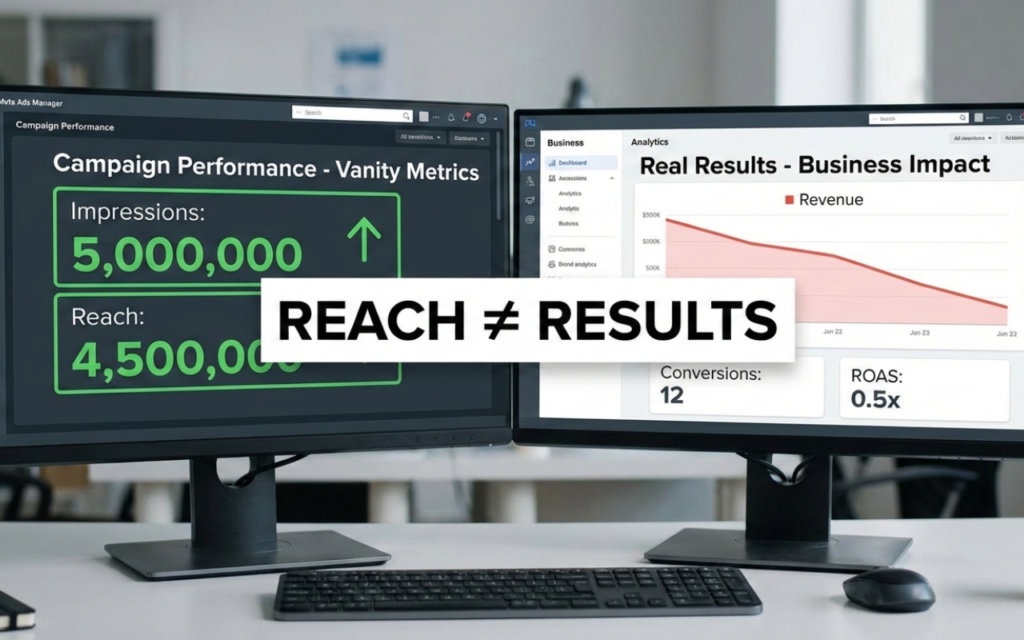
If you’re a small business owner running Meta ads, you’ve probably opened Ads Manager, seen massive reach numbers, and assumed your campaign was working. But in 2026, Meta ad efficiency matters far more than how many people see your ad. You can reach tens of thousands of users and still lose money if those impressions don’t convert into real revenue.
At first glance, high reach feels like progress. It looks impressive in reports. It’s easy to screenshot. But then you check your leads, bookings, or sales—and nothing has changed.
That’s because reach is a vanity metric.
In today’s digital advertising landscape, reach is cheap. Attention is expensive. Conversions are everything. The businesses winning in 2026 aren’t the loudest in the feed; they’re the most efficient with every dollar they spend.
At Atlas Unchained, we consistently audit Meta ad accounts where businesses are spending thousands each month chasing visibility while their return on ad spend quietly collapses. If you want to survive—and scale—in the next phase of digital marketing, you need to stop optimizing for reach and start optimizing for efficiency.
What Is Meta Ad Efficiency (And Why It Matters Now)
Meta ad efficiency is the relationship between what you spend and what you get back. It’s not a buzzword. It’s the core metric that determines whether your advertising is sustainable or slowly draining your business.
Reach tells you how many people saw your ad.
Efficiency tells you whether those people took action—and whether that action was profitable.
Think of it this way:
- Reach is how many people walked past your storefront
- Efficiency is how many walked in, bought something, and how much it cost to get them there
In 2026, Meta’s algorithm doesn’t reward exposure for exposure’s sake. It rewards outcomes. If your campaigns don’t generate meaningful conversion signals, Meta will charge you more to keep showing your ads.
The Meta Ad Efficiency Equation
To understand Facebook advertising ROI today, you need to focus on three core performance metrics—not vanity numbers.
1. ROAS (Return on Ad Spend)
ROAS answers one question: For every dollar you spend, how much revenue do you generate?
If you can’t clearly track or justify your ROAS, scaling becomes guesswork.
2. CPA (Cost Per Acquisition)
CPA tells you how much it costs to acquire a lead, booking, or customer.
A rising CPA is often the first sign your ads are inefficient—long before your budget runs out.
3. Conversion Rate
This measures how many users who click your ad actually complete the desired action.
Low conversion rates usually indicate:
- Weak or generic messaging
- Poor landing page experience
- Misaligned audience intent
Years ago, advertisers could rely on broad targeting and still win. In 2026, that approach gets punished. The advertisers who thrive are the ones who feed Meta’s AI clean data and clear conversion signals.
Why Reach Is No Longer the Goal
Industry analysts and platform data point to the same conclusion: ad efficiency—not reach—is Meta’s real battleground. Here’s why.
1. Signal Loss Changed Everything
Privacy updates and tracking restrictions dramatically reduced Meta’s ability to follow users across the web. When advertisers optimize for broad reach, they dilute intent signals.
If you’re targeting everyone, you’re effectively targeting no one.
Efficient campaigns rely on conversion behavior, not demographic guesses.
2. Rising CPMs Punish Inefficiency
Ad costs continue to rise across almost every competitive industry. Small and mid-sized businesses can no longer afford campaigns that “build awareness” without producing measurable results.
Digital marketing efficiency isn’t optional anymore. It’s a survival requirement.
3. Meta’s AI Optimizes for Outcomes
Meta’s algorithm is now better at predicting who will convert than most human marketers. But it needs the right signals.
Campaigns that generate strong engagement-to-conversion ratios are rewarded with:
- Lower CPMs
- Lower CPAs
- More stable delivery
Campaigns optimized only for reach are penalized with higher costs and declining performance.
Why You’re Getting Reach but No Sales
One of the most common frustrations businesses face is seeing traffic without results.
This usually comes down to a message-to-market mismatch.
Your ad may be interesting enough to stop the scroll, but not compelling enough to earn trust or drive action. In other cases, the ad promise doesn’t match the landing page experience, creating friction that kills conversions.
Other efficiency killers include:
- Generic creative that blends into the feed
- Weak offers or unclear CTAs
- Poor tracking or attribution
- Slow or confusing websites
Reach hides these issues. Efficiency exposes them.
3 Proven Ways to Improve Meta Ad Efficiency in 2026
At Atlas Unchained, we focus on systems—not theory. Here’s how to shift from reach-driven campaigns to conversion-driven performance.
1. Creative-Led Targeting
In 2026, your creative is your targeting.
Instead of obsessing over interests and lookalikes, focus on messaging that clearly speaks to different buyer motivations.
The framework:
- One ad focused on a specific pain point
- One ad focused on a clear outcome or benefit
- One ad built around social proof or testimonials
Meta’s AI will identify which message resonates with which audience segment—and optimize delivery accordingly.
2. Implement the Conversions API (CAPI)
If you’re still relying solely on the Meta Pixel, you’re missing valuable data.
Conversions API sends conversion events directly from your server to Meta, improving:
- Attribution accuracy
- Signal reliability
- Campaign optimization
Businesses using CAPI consistently see lower CPAs and more stable Facebook advertising ROI because Meta has better data to work with.
3. Ruthless Testing and Pruning
Most advertisers waste time debating creative instead of testing it.
Launch fast. Test multiple headlines, visuals, and descriptions using dynamic creative. Let performance decide.
If an ad doesn’t hit your target CPA within 48–72 hours, pause it. Scale what works. Cut what doesn’t.
Efficiency rewards speed and decisiveness.
What Efficient Meta Ads Have in Common
High-performing Meta ad accounts in 2026 share the same traits:
- Clean tracking and attribution
- Conversion-focused objectives
- Clear, specific messaging
- Continuous creative testing
- Aggressive budget reallocation
They don’t chase reach. They earn it through results.
People Also Ask (AEO Section)
How do I improve Meta ad efficiency?
Focus on conversion-driven creative, implement Conversions API tracking, and optimize based on CPA and ROAS instead of reach.
Is reach or impressions more important for Meta ads?
Neither. They are top-of-funnel metrics. Conversion rate and ROAS define success for most businesses.
Why are my Meta ads getting clicks but no sales?
This usually indicates weak messaging, poor landing page alignment, or inefficient tracking.
Are Meta ads still worth it in 2026?
Yes—but only for advertisers who prioritize efficiency, data quality, and creative performance.
The Atlas Unchained Approach: Systems Over Surface Metrics
There’s no shortage of marketers talking about brand awareness and long-term visibility. That works if you have massive budgets.
For growing businesses, results must be measurable.
Our process is simple:
- Audit – Identify waste and data gaps
- Optimize – Fix tracking, creative, and conversion flow
- Scale – Only once efficiency is proven
When efficiency improves, reach follows naturally.
FAQ: Meta Ad Efficiency in 2026
Should I stop focusing on reach entirely?
No—but reach should be a byproduct of performance, not the goal.
How much should a small business spend on Meta ads?
Enough to generate at least 50 conversions per week per ad set to exit the learning phase.
Does video outperform static ads?
Often yes, but relevance always beats format. Test both.
Ready to Stop Wasting Ad Spend?
The Meta ads battleground of 2026 belongs to efficient advertisers.
If your strategy is still built around reach and impressions, you’re overspending and underperforming—while smarter competitors take your market share.
Contact Atlas Unchained for a comprehensive digital marketing audit.
We’ll identify the waste, fix the system, and build a Meta Ads engine that drives real growth—not vanity metrics.