

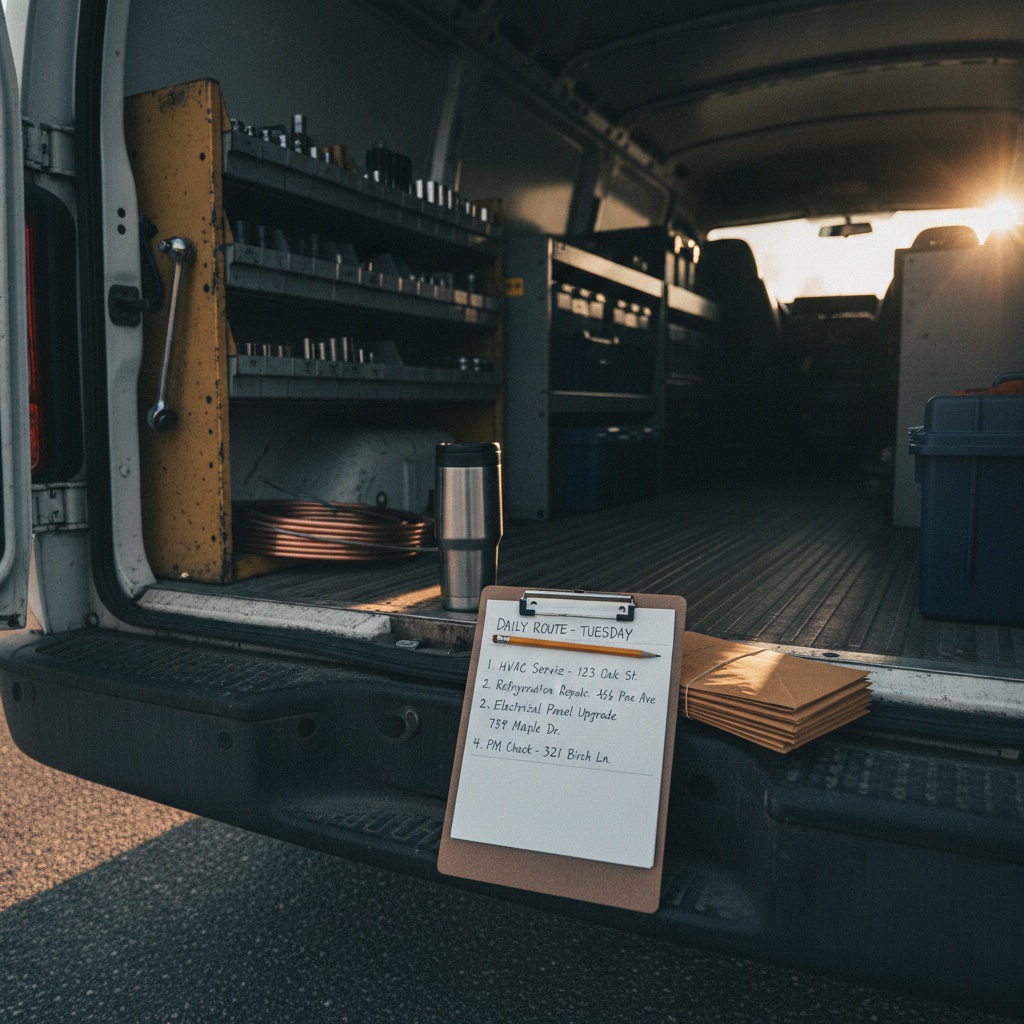
Most trades shops run their technicians at 65 to 80 percent utilization. The top crews hit 80 to 90. That gap is not laziness. It is drive time, and poor route planning quietly burns 20 to 30 percent of a tech’s paid day without billing a customer a dime. Run the math on a five-truck HVAC shop and the lost hours add up to a sixth truck you already pay for but never bill.
Here is the part owners miss. The fix is not another tech. It is the order you send the techs you already have. AI dispatch tools that landed in the major field-service platforms over the past year reclaim a chunk of that drive time and, more important, put your best closer in front of your biggest job. This is a field-operations lever, not a software toy. Let us price it and stage it.
The number that pays your trucks
Technician utilization is billable hours divided by paid hours. A tech on the clock eight hours who bills five is running 62 percent. That number, not your phone-answer rate and not your review count, decides whether a truck makes money. Field-service benchmarks for 2026 put healthy shops at 65 to 80 percent and elite shops at 80 to 90. Push past 85 and you start trading quality for burnout, so the real target for most shops sits in the high 70s.
Drive time is the biggest leak. Industry route studies show distance between jobs eating 20 to 30 percent of the workday. AI routing cuts travel by roughly 20 percent in published results, which is enough to fit two more jobs on a truck per day and lift on-time arrival from 76 to 91 percent. One electrical contractor case put utilization up 18 percent and billable hours up 25 percent after moving dispatch off a whiteboard and onto scheduling software with live visibility. That is the prize.
Why gut-feel dispatch costs you two jobs a day
A human dispatcher holds maybe ten variables in their head. A good one is worth their weight in gold. But on a busy morning they default to whoever is closest or whoever called in first, and they cannot see that the closest tech is also your weakest closer on a $14,000 system replacement. They also cannot re-solve the whole board when a 10 a.m. cancellation opens a hole near a tech who is now 40 minutes out of position.
That is the exact problem optimization software solves. It does not get tired at 2 p.m. It re-sequences the day every time something changes, and it weighs the things a whiteboard cannot: drive time, the part on the truck, the skill match, and on the better platforms, the revenue and close rate of the assigned tech. The result is fewer dead miles and more high-value jobs landing with the tech most likely to sell them.
The honest catch: none of these tools are magic, and a board with bad job-type data in feeds them garbage. You have to tag job types, skill sets, and truck inventory cleanly first. Dispatch AI amplifies a tidy operation and embarrasses a sloppy one.
The AI dispatch stack, priced
Three platforms cover most shops with 3 to 30 trucks. Pick by where you sit on price and complexity.
ServiceTitan Dispatch Pro is the heavy hitter. It predicts job value and assigns the right tech using recent performance, estimated revenue, drive time, and skill match. The notable design choice is that it optimizes for revenue, not just efficiency, so it will send a farther tech to a big-ticket job if that tech closes more of them. It is powerful and it is expensive. ServiceTitan runs custom enterprise pricing that typically starts in the high hundreds per tech per month once you add the AI tiers, so it earns its keep above roughly $2M to $5M in revenue with a dedicated dispatcher.
Jobber Copilot is the value pick. Copilot is built into Jobber and reads your schedule and customer data to recommend scheduling and routing moves and flag jobs you would otherwise miss. It is free inside Jobber plans that run roughly $30 to $250 a month for the business depending on tier and seats. It will not revenue-weight your board the way Dispatch Pro does, but for a 3 to 8 truck shop it covers the routing basics without a five-figure commitment.
Housecall Pro sits in the middle. Its scheduling AI is functional and its AI accounting features are genuinely unique among the three, though its dispatch optimization is not as sophisticated as Dispatch Pro’s revenue weighting. Plans land in the low hundreds per month for a small team. It fits the HVAC, plumbing, and electrical shops living in the gap between Jobber’s simplicity and ServiceTitan’s depth.
If you want pure routing on top of whatever CRM you already run, dedicated route engines plug in for $20 to $40 per tech per month and handle the travel-time math alone. That is the cheapest way to test the drive-time thesis before you re-platform.
A two-week rollout that does not blow up your board
Do not flip the whole shop to AI dispatch on a Monday. Stage it.
Days 1 to 3: clean the data. Audit your job types, skill tags per tech, and what inventory lives on each truck. The optimizer is only as good as these fields. Most shops find half their techs are tagged identically when they are not. Fix that first.
Days 4 to 7: shadow mode. Turn the recommendations on but keep your dispatcher driving the board. Each morning, compare the software’s suggested route to what your dispatcher actually did. Log the difference in miles and in job value. You are building trust and catching the cases where the model is wrong because your data is wrong.
Days 8 to 14: hand over the routine. Let the tool sequence standard service calls and tune-ups automatically. Keep your dispatcher on the judgment calls: the angry customer, the warranty mess, the VIP commercial account. Measure utilization and billable hours against your week-one baseline. If you cannot show a gain in two weeks on a clean board, the tool is not the problem and you should look at capacity, not routing.
Track two numbers through the whole test. Utilization rate, because it tells you whether trucks are billing more. And jobs per truck per day, because it tells you whether the reclaimed drive time turned into real work or just slack. A shop that adds even one job per truck per day across five trucks is booking 25 extra calls a week off the same payroll.
The decision to make this month
Pull last month’s timesheets and your dispatch log. Compute one number: average billable hours divided by paid hours per tech. If it is under 70 percent, drive time and gut-feel dispatch are costing you a truck’s worth of revenue, and the fix is a software change you can pilot for the price of a route add-on. If you are already above 80, your leak is somewhere else and AI dispatch will only buy you a few points.
The platforms are not mature and they are not interchangeable. ServiceTitan buys revenue-weighted optimization at an enterprise price. Jobber buys routing basics for free. Housecall Pro splits the difference. Match the tool to your truck count and your dispatcher’s bandwidth, run the two-week shadow test on a clean board, and let the utilization number tell you the truth. That is a far cheaper way to add capacity than hiring a tech you cannot find in a market still short more than 100,000 of them.
We build the dispatch-data cleanup and the pilot scorecard for trades shops at Atlas Unchained, so you measure the gain instead of guessing at it. If you want the two-week rollout run for you, that is what we do.
About the Author
Trevor Kaak is the founder of Atlas Unchained, a portfolio of products and services helping local businesses run leaner with AI — from custom websites to vendor-bidding marketplaces to vertical SaaS. He writes about marketing, automation, and the craft of building software for operators who’d rather work on their business than in it.


